
Þögnfar
Some wounds are not meant to close. They are meant to listen.


There is an ephemeral nature in being able to hear leaves of grass peek their blades through soil. He laughs at their impact; not scorn, but softness. To hear the earth move is no small thing, and he rarely ceases to be amazed by it. Lately though, there’s been a rustling deep within the surface; more than the memory of Gjallar, but the weight of it in his palms when the horn was handed to him by Odin.
“Do you ever tire of listening to the earth, Heimdall?”
The question comes from above or below.
“Don’t you ever wish to see them burn?”
He doesn’t answer.
Living with voices and thoughts that are not his is no small thing. That is the price of standing guard near Bifröst, the bridge where light reflects and refracts and mortals claim it is very beautiful.
Beauty, he thinks, beauty is not as simple as a glance.
“And to think,” he mutters to himself, “To think I gave up an ear for all this.”
The constant murmuring, the shuffling of glances, the hierarchy of social classes.
I wish, he thinks. I wish I could have an encounter with someone who would be transparent with me.
He hears the echo of laughter and runs his tongue along the back of his gold teeth.
There is the lick of flames in his eyes from the burning fire on the bridge. The red is glaring, more ominous than usual. Within his chest, there is a trace of foreboding. The hands of time are moving. He can feel the tides shifting, drawing nearer to the shorelines than they ever have. Soon, he thinks, it will happen soon.

He recalls Loki and the sly manner in which he morphed into a fly who clung to a wall before stealing Freyja’s necklace. Heimdall smiles at the memory where he tracked him down and both became seals in battle. Though the thrashing and biting was ruthless and bloody, he felt pride in honouring a woman.
There is veracity in having a clear nemesis, one who never pretends to be anything other than what he is. God or not, Loki deserves to be bound by the intestines of his own son for what he did to Baldr. The absence of light is no small thing. He hears Hel humming in the world below and wonders if it pains her to think of the poison dripping on her father. He is glad she is where she is and not Midgard where the earth quakes, though he suspects she knows by the growing rate of bodies.
I am nothing but an eagle-eyed messenger, he thinks. A watchman for those who have been spared the weight of realms.
There are instances when he longs to be more than a herald. It is a lifetime of waiting, some adventures along the way, each moment carrying the seed of a prophecy. He paces the hall, the place that is tall enough for him to catch sight of intruders. To be a guardian for the gods, he has had to learn the value of trust.
Thor is wading through the rivers underneath Bifrost. Even from a distance, he is a looming presence, red-bearded and broad-shouldered with a fierceness in his eyes.
“You’ve come for Urðarbrunnr?” Heimdall calls out.
“I see your sight is as keen as ever, watchman,” Thor says. “I have indeed come to visit the well of fate.”
“May you find the counsel you seek.”
He watches Thor depart in the direction of the well beneath one of the three roots of Yggdrasil and catches the pungent and sulphurous odor of the sea.
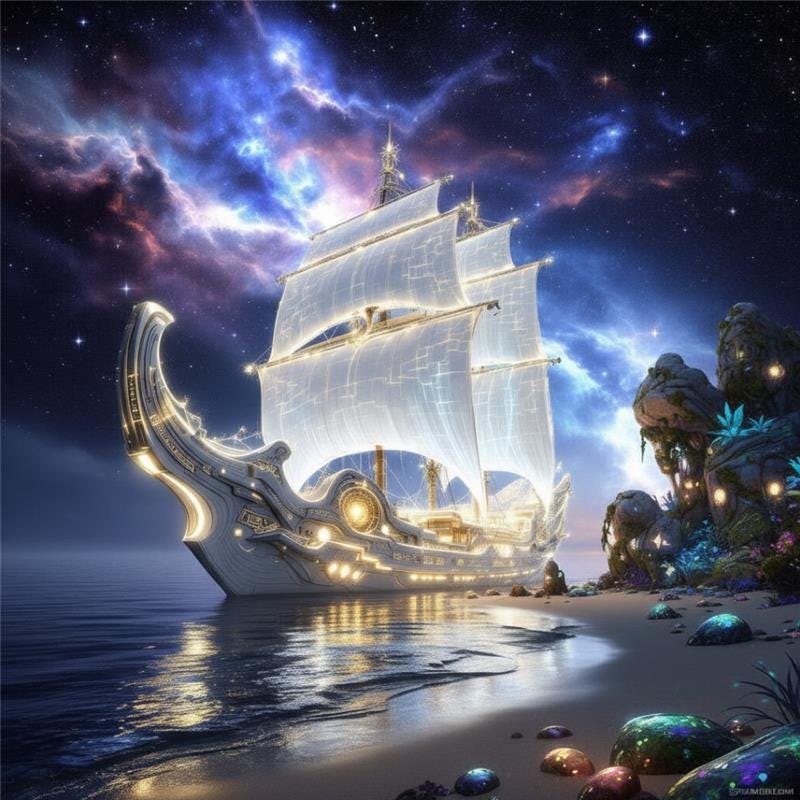
Beyond the furthest rim of sea, something pale interrupts the horizon. Not foam. Not wreckage. A narrow hull, bleached and waiting.
His ship.
It does not drift. It does not approach. It remains - as if the tide itself refuses to decide. He sees it. He lets his gaze pass over it. He recalls his last visit to Vanaheim.
He had not been for some time. Beyond the burning arch of Bifröst, where the salt wind sometimes climbs higher than it should, there was a narrow boat that lay in wait near a shoreline. The land beyond was lush and green, brimming with magic from the Vanir.
Despite his aversion to the churning nature of the sea, Heimdall placed his hands on its bow and pulled it into the water. He stepped into the hull and sat for a moment, appreciating how the driftwood appeared to have been bleached white. He had built the vessel piece by piece. Half-wreckage, half-planks he’d carved and sanded with careful precision.
One can’t be owned by fear, he thought. There is a necessity to be able to examine a wound.
The sea was a face he was reluctant to gaze into. It carried the same salt that filled his lungs when the nine sea maidens cast him away. The same cold that held him before Odin’s arms did.
“You are a meeting between sky and sand,” Odin had whispered affectionately, holding his forsaken child close to his chest.
Heimdall perched in the hull remembering. He lifted his eyes from the pale and splintering wood that carried his weight to the horizon. There was a flash of red sea foam that resembled bloody hair. In a blink, it was replaced with a great swelling. He placed his hands on either side of the vessel. He ran his palms along the vessel’s ridges and understood that any experience left unfinished will carve its own hollow.
The wood answered beneath his touch - not in sound, but in recognition.
Þögnfar.
The name did not come from him. It rose through the grain, as though the silence had always known itself. Not a ship for crossing - a ship for holding.
When the vessel returned him to the shore without wading further, he knew he would never wade any farther.
When he returns to the present, he is standing guard at Bifröst. Thor is communing with some gods. A drop of dew falls to the soil from a strand of grass. At maximum perception, Heimdall’s eyes emit an amber glow. There is the scraping of nails in the churning rivers below. He lifts the Gjallhorn to his mouth and presses his lips against it. There is a scraping of wood against his mouth. He clamps the trunk against his chest.
I could never get away that easy, he thinks.
His was never a ship for crossing. It was a ship for holding. Another flash of flesh in the distance, a hull built to contain a sound not yet given. A vessel for a warning that had chosen to wait. He could have taken it farther. He did not. And his hate for himself is the origin of his arrogance.
His longing is a bruise in the air, and he wishes that he didn’t long in the manner in which he does. It is not fitting for a god to feel with such profundity.
On the horizon, the pale hull remains and he recalls Odin’s face looking over him with such tender care. He wants to remain unmoved.
It begins before the sound. The pulse of his breath in the air. This was never a ship for crossing. It was a ship for holding, but can a god ever be held in the manner in which they desire to be?
The pale hull staying out there and not deciding is so rude... 😆 One little boat doing all that to my chest, honestly..!
I'm starting to think you may have come from Midgard yourself... Sublime work.